Drilling Process
We expect to drill about 2000 production wells in southern Queensland under the first stage of our QCG Project. This is set to expand to about 6000 over the life of the project. Find out more about the drilling process we use.
There are two main types of well: exploration and production.
An exploration well helps us to understand the nature, size and commercial viability of a gas reserve, while a production well allows us to bring the gas to the surface.
A production well is drilled using a series of rigs that descend through the different layers of earth below ground.
Most of the production wells we have drilled to-date are between 300 and 800 metres deep and target gas trapped in the Walloon Coal Measures in the Surat Basin.
If there are several wells on a plot of land, they will normally be around 750 metres apart.
A well site
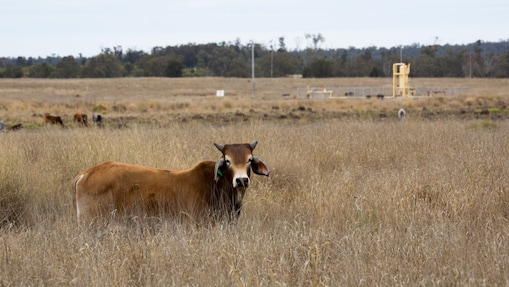
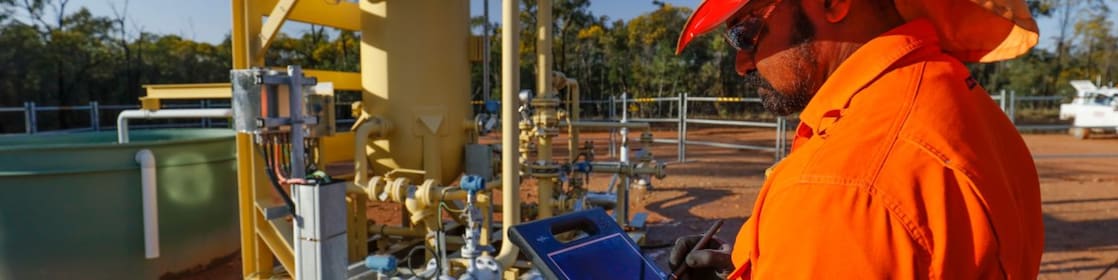
Normally, you can tell a well site because it includes the following items above ground: wellhead; separator; telemetry enclosure and antenna; connecting flow lines; flare stack; and hydraulic power unit.
A typical well site incorporates the following key items:
- Wellhead - provides a pressure seal to ensure the flow of gas and water is controlled.
- Hydraulic power unit - provides the hydraulic power to drive a pump at the bottom of a well.
- Remote telemetry unit - links the wellsite facilities to a control system for remote operation.
- Hole pump - dewaters the well so that the gas will flow to the surface.
- Separator - separates the gas and water that is produced from the well.
- Booster pump - drives produced water to water treatment plants.
- Solids disposal tank - safely collects and stores solids from the separator.
- Connecting flow lines - these pipes take the gas and water to processing facilities.
Protecting groundwater
Our wells are designed in such a way that gas and water will travel directly from the extraction point inside the well to the surface without any connection with groundwater.
The gas and produced water is isolated from surrounding aquifers by one or two layers of steel casing, which is held in place with impermeable cement.
Site selection and setup
Site selection and setup
Care and precision
In selecting a well site, we first check with the landholder on a preferred location for the drilling and the connection of gathering pipe systems and access roads.
Strict environmental regulations are adhered to and we consider potential impacts on landholders and nearby residents proceeding.
Survey team
A team of up to 10 QGC people representing disciplines including environment, cultural heritage and safety will typically undertake a half-day visit to the property as a first step.
Known as a pegging party or survey team, this group will work with the landholder to identify locations for infrastructure and understand any associated impacts.
We use this opportunity to obtain a detailed understanding of the landholder's daily business operations and requirements in terms of access, safety and security, and construction impacts.
While looking at the terrain and commercial viability of the gas reserves, we consider all potential consequences of our work on livelihoods, cultural heritage, agriculture and local biodiversity. This helps us to determine the best position for wells and supporting infrastructure and design appropriate mitigation, if necessary.
Setting up the site
Before a drilling rig is installed, an area approximately 100 metres by 100 metres is prepared in consultation with the landholder.
Clearing involves collecting leaf mulch, topsoil, subsoil, root systems and other vegetation matter, which will be stockpiled separately for reuse. Gravel may be used in the construction of the well site.
We will relocate any animals found during the clearing process.
Accessing a site
Accessing a site
In partnership with landholders
QGC and landholders will agree on access rules that our staff and contractors are required to follow.
These rules reflect all conditions of entry and extend to requirements regarding gates, stock, vegetation and weed management, as well as fencing, hygiene and re-seeding.
A minimum notification period will be agreed in these access rules for all day-to-day operations and construction and drilling activities.
As part of our ongoing preparations, we will lay out safety procedures and identify exclusion zones and traffic management requirements and constraints.
Agreeing access tracks
Wherever possible, we seek to use existing access tracks or design routes along current fence lines. If necessary, we will upgrade existing tracks or build new ones to minimise interference to other road users.
We aim to leave existing public roads and tracks within the property in at least as good a condition as when work began.
Construction is undertaken by suitable civil contractors and takes into account landholders' needs, safety and the environment.
Related information:
Well drilling and operations
Well drilling and operations
Some things can't be rushed
It takes careful planning, precision and strict safety procedures to build a gas well.
After a well site has been marked out and cleared, and access agreed with the landholder, a drilling rig will be put in place.
Drilling rigs penetrate into the soil and rock below, creating a hole - or wellbore - from which we can extract the gas from hundreds of metres under the surface.
Several rigs of varying size will usually be deployed to construct a well. Other equipment you might expect to see on site during well construction include generators, office buildings, storage facilities, trailers and lighting towers.
Beginning the drilling
Built in multiple stages, each section of the well will be lined with steel casing and cemented before the next stage in drilling continues.
The cement is similar to that used in buildings but is of a higher quality grade. This ensures that the different geological formations drilled through are isolated from the well and one another.
A steel conductor pipe, measuring 5 to 10 metres in length, is installed by the first - and smallest - of the drilling rigs. This pipe provides a stable foundation for subsequent work. A larger rig will then be mobilised to the site to drill a wellbore of about 30 centimetres in diameter.
Completing the drilling
Over the next day or two the main rig drills a deeper wellbore of about 20 centimetres in diameter to about 300 to 800 metres below the surface.
A long section of pipe known as casing, through which the gas will be extracted, is then run into the wellbore from the surface.
A completion rig, slightly smaller than the main drilling rig, is used to test production and install a wellhead and safety equipment at the surface. A pump is fitted at the bottom of the well, which will assist the flow of water up the wellbore. Removal of the water allows the gas to flow.
Once construction is completed, each rig is transported to another location.
Water and hydraulic fracturing
Extracting water from the coal lowers the pressure that has kept the gas in place and allows it to flow from the coal seam and rise to the wellhead.
Although water flows freely in some production wells, others require a pump to extract water. If the rate of production from a well needs to be increased, we may use a technique called hydraulic fracturing to draw out the gas.
Widely used worldwide by the gas industry since the 1950s, hydraulic fracturing uses a high-pressure pump to inject mostly water and sand into the well to create tiny cracks and hold them open, allowing more gas to flow.
Operations
Once a well is drilled, we will test the rate at which gas flows to confirm its viability. This involves monitoring the well 24 hours a day over a 60-day period.
Gathering pipes are installed to take water and gas to treatment facilities.
Monitoring and rehabilitation
Monitoring and rehabilitation
We take care of our wells
Our safety and security policy requires that we go "beyond compliance".
This means we aim to do more than government regulations require to ensure that health, safety and security and environmental protection is assured.
Designed to last up to 25 years, our wells are inspected regularly by trained field operators and monitored on an ongoing basis.
Monitoring
Instruments attached to many of the wells transmit key data, such as gas flow rates, to a central control room.
Wells can be shut down or opened remotely from this control room.
If maintenance is required, a workover rig, similar in structure to a drill rig, may be brought in to repair the well. We also monitor and maintain surrounding site infrastructure, including gas engines, gathering pipes, separators and pump drive units.
Site rehabilitation
After construction, the land around a well will be rehabilitated, in consultation with the landholder and in line with regulations. The ground will be re-seeded and erosion control measures put in place.
At the end of a well's life, surface infrastructure will be removed and the wellbore secured.
Exploration wells
Exploration wells
Our preliminary drilling
Exploration wells are drilled in areas identified by survey data as having potential for gas production.
Our aim in installing one of these wells is to gather as much information as possible about the nature, size and viability of the reservoir and its contained gas.
If an exploration well is judged to be a success, it will be modified for production. An unsuccessful well will be decommissioned and the area rehabilitated.
Working with landholders
Before entering a property we are obliged to give notice of entry and to negotiate in good faith to agree compensation with the landholder.
We also know that we must do much more than merely meet the letter of the law. For instance, we negotiate the location of wells and infrastructure. Every piece of infrastructure on a property is there with the permission of a landholder.
A key factor in deciding the most suitable location for our wells and associated infrastructure is our ability to minimise impact on individual landholders to ensure the co-existence of agriculture and gas production.
We take account of the location of homes, cattle yards, community assets such as schools, roads, good quality agricultural land, farming practices, topography and geology as well as cultural heritage and environmental constraints.
As required by law, QGC pays compensation to owners and occupiers of land affected by gas development.